

Steedman
Steedman Accountants
"Steedman Accountants is a growing firm specialising in SMEs and innovative sectors like cryptocurrency and R&D tax relief."
The R&D tax landscape has changed significantly over the past year.
As firms navigate the merged scheme, overseas restrictions and new administrative requirements, attention increasingly turns toward how R&D claims are delivered in practice.
Strong technical expertise remains essential. What has become equally important is the structure surrounding how that expertise is applied, ensuring claims are consistent, well-documented and able to withstand scrutiny.
Despite the increased complexity, R&D tax relief remains an important area of support for innovative companies, and a valuable advisory service for firms that can deliver it well.
In response, many firms are placing greater emphasis on how R&D claims are prepared in practice…
See in real-time how firms are preparing consistent, compliant R&D claims with greater structure and support, by booking a demo.

These changes are reflected across several key areas of the R&D tax scheme.
The following highlights where the most notable updates have occurred, and how they affect the preparation of claims in practice:
The merged scheme
The introduction of the merged RDEC scheme has brought together elements of the previous SME and RDEC regimes, changing how claims are calculated and presented. While this has simplified certain structural differences between schemes, it has also introduced new considerations around eligibility intensity and transitional claims, particularly for companies with accounting periods spanning the change.
Overseas restrictions
Under the merged scheme, restrictions on overseas expenditure now apply to subcontracted R&D and externally provided workers, with only limited exemptions. While the rules are clearly defined in legislation, applying them in practice often requires careful assessment of where activities are carried out, and how costs are structured and evidenced.
Subcontracting rules
Changes to subcontracting rules have shifted the focus toward understanding who initiated the R&D, and whether R&D was anticipated at the outset of a contract. This has introduced a more nuanced approach to determining which entity can claim, requiring clear documentation and consistent application across different client scenarios.
Reporting requirements
The introduction of the Additional Information Form (AIF) has increased the level of detail required when submitting R&D claims. Firms are now expected to provide more granular information on projects, costs and methodologies, reinforcing the need for structured information gathering and clear documentation throughout the claim preparation process.
Claim notification
Pre-notification requirements through the Claim Notification Form (CNF) have introduced an additional step in the claims process for certain companies. Missing a notification deadline can prevent a claim from being made, placing greater emphasis on identifying potential R&D activity early and maintaining appropriate internal processes.
Taken together, these changes increase the operational expectations placed on firms preparing claims.
Firms preparing R&D claims are currently operating across multiple regimes.
Operating confidently across these frameworks requires more than technical understanding – it requires processes that support consistent and well-documented decision-making.
WhisperClaims is designed to support accountants navigating this complexity while retaining full control over the claim preparation process.
Our platform provides:
WhisperClaims does not replace professional judgement. It supports it with structure, visibility and access to experienced technical input when needed.
For firms reviewing how R&D is delivered internally, exploring additional structure and support is often a practical next step.
The Claim Notification Form (CNF) in practice: a snapshot three years on
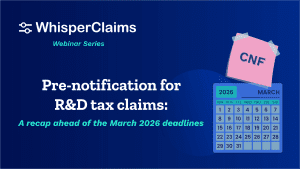
Pre-notification is now a routine part of the R&D tax process, but it’s still catching firms out. This article recaps a recent webinar looking at how the CNF is being applied in practice, the risks of getting it wrong, why a more structured approach to claim preparation is becoming essential – plus poll outcomes from our audience…
Subcontracted R&D EPWs and overseas costs: Webinar catch up

The rules around subcontracted R&D and overseas costs have fundamentally changed under the merged scheme. This article unpacks the practical implications for accountants highlighting the need for clearer records, stronger processes and a more structured approach to claim preparation – plus access to our recent webinar
“Fundamentals of the R&D tax Scheme” Training Course (Online)

In this monthly, live, interactive session, our in-house R&D tax expert, Jen Badger, will guide you through the fundamentals of the R&D tax scheme(s) to set you on the right path to offering a knowledgeable and professional service to your clients. Groups are purposely kept small ,so spaces limited – book now!

Steedman Accountants
"Steedman Accountants is a growing firm specialising in SMEs and innovative sectors like cryptocurrency and R&D tax relief."

WMT Chartered Accountants
"I was incredibly impressed all-round. Given that, the knowledge the team has and a really fair cost, we didn’t feel the need to compare with other products on the market."
Hertfordshire | England

Inglis Chartered Accountants
"One of the great things about the software is that we can access an ‘opinion service’ to access the viability of a claim before we start collating information, or even before a client starts their project."
York | England

ChadSan Ltd
"The support is brilliant. They reply to me so quickly, and always with a solid answer that helps me get on with my work. Just having someone on the end of the phone has been really helpful."
Guildford, Essex, Bristol | England
© 2026 Wobbegong Technology Ltd (Registered number 10754811), trading as WhisperClaims.
WhisperClaims is a registered trademark of Wobbegong Technology Ltd (Trade Mark No.: UK00003360482).


